|
Data Collection
|
|
Granger, Steve, Olde, Louise, Hodgson, Chris, Blackwell, Martin, Sint, Hadewij, Quincke, J. A., Harris, Paul
|
|
Darch, Tegan
|
|
grasslands; nitrogen; phosphorus; turbidity; Faecal coliforms; Escherichia coli; flow rate
|
|
BB/L009889/1, S2N - Soil to Nutrition - Work package 1 (WP1) - Optimising nutrient flows and pools in the soil-plant-biota system, The North Wyke Farm Platform- National Capability [2017-22], Maximising carbon retention in soils
|
|
1 November 2022
|
|
|
|
Devon, SW England, UK
|
|
|
|
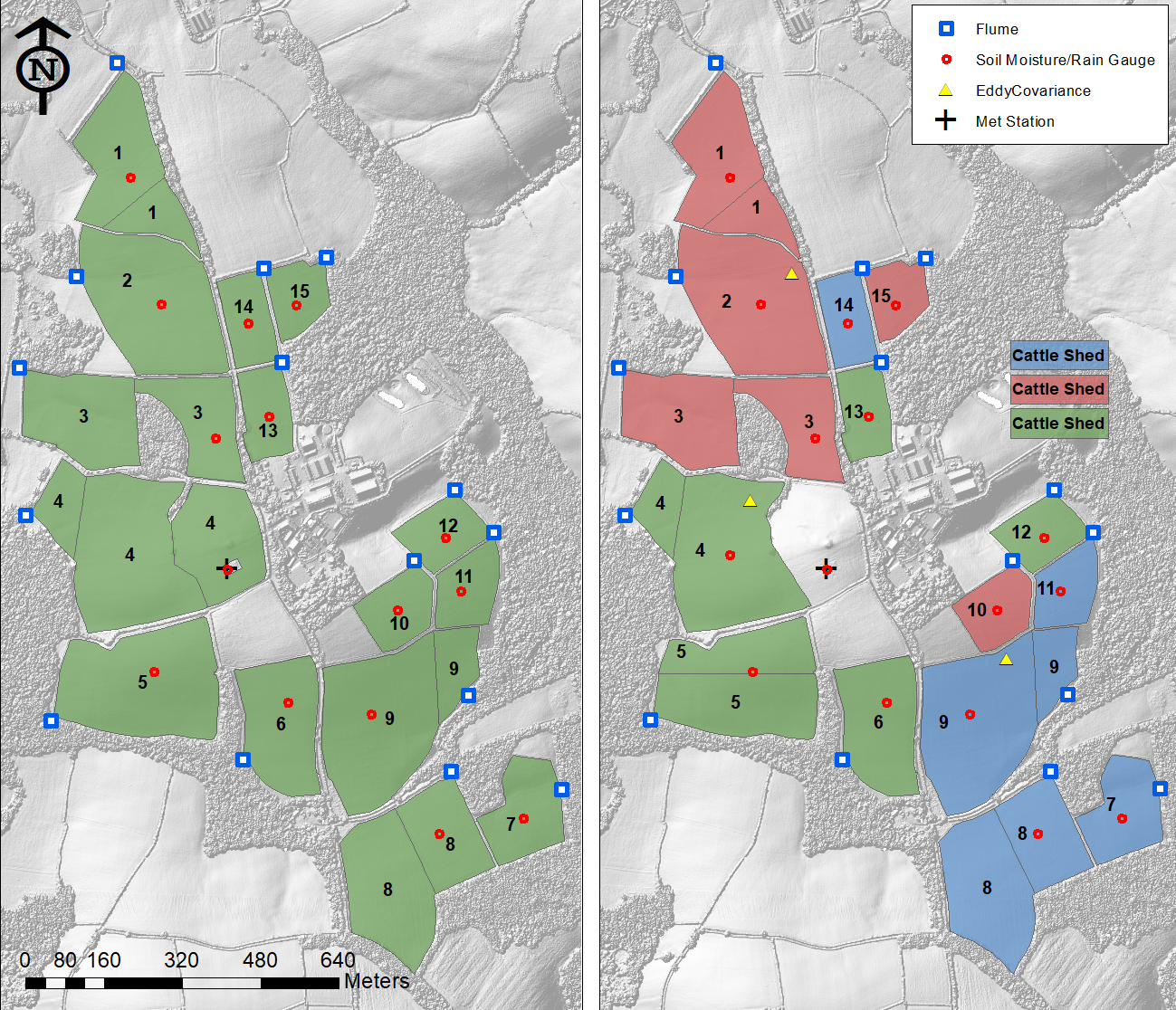
This dataset contains water quality information of combined surface and subsurface runoff, taken from catchments on the North Wyke Farm Platform (NWFP). The NWFP is separated into three self-contained farms (“farmlets”) which are managed according to different operational philosophies or practices, and these farming systems are updated periodically. During the period over which this dataset was collected, the three 22ha farmlets were all pasture based and used for livestock production in the form of a beef herd and sheep flock. From 2010 to between 2013 and 2015 (depending on the catchment) the farmlets were all under permanent pasture (map 1 in figure), and are referred to as the ‘baseline’ period in the Treatment column of the data. The first system change period (2013/5 to 2019, map 2 in figure) was either a reseed with innovative grass species with desirable traits (‘reseed’ in the Treatment column of the data), reseeded with a mixture of white clover and the same innovative grass species (‘legumes’), or continued permanent pasture (‘permanent pasture’).
The fields of the NWFP are hydrologically isolated, and the highly impermeable subsoil means that water moving as surface or subsurface runoff is captured by a bounding drainage system and directed towards a flume, with one flume per catchment. Each farmlet consists of five catchments and are highly instrumented and monitored, allowing the collection of a wide variety of environmental data to complement agricultural production data. Core NWFP datasets are open and include in-situ water flow and chemistry taken at 15-minute intervals; 15-minute Met measurements; 15-minute soil moisture measurements; 30-minute GHG emissions; soils, crop and botanical field survey data; livestock and crop performance data; and farm operational activities (see additional information).
The environmental data collected at each catchment includes water chemistry measured in-situ at 15-minute intervals in the discharge (from surface and subsurface flow) from each catchment. However, at low flows (< 0.20 L s-1), in-situ measurement is not possible due to a lack of water available to flush and refill the flow cell where these measurements are made. As different hydrological processes and a lack of dilution means that water chemistry at low flow may differ from at higher flows, this dataset was collected to address gaps in water chemistry data at low flow. This was expanded to cover non-storm baseline water samples that had a flow of > 0.2 L s-1.
Two datasets are included as they both provide measurements at low-flow. The ‘FP031’ dataset contains water chemistry and pathogenic faecal indicator organism data taken from weekly grab samples from 25/3/2015 to 18/5/2016 from six catchments. The ‘FP083’ dataset contains water chemistry and suspended sediment data taken on an ad-hoc basis from seven catchments between 19/10/2017 and 7/2/2018. In addition to the experimental data, where the water quality was assessed in the lab, in-situ data have been included where they were felt to complement the dataset. As some measurements were made both in the lab and in-situ, column names include the subscripts ‘_lab’ or ‘_portal’ respectively.
In the ‘FP031’ dataset, samples were taken on a weekly basis from 6 catchments on the NWFP, with two catchments from each of the three farmlets. At each catchment, a manual estimate of discharge rate (‘flow_manual’) was made from the front of the weir using a stopwatch and a volumetric cylinder; three estimates were made, and an average taken. The time of the manual flow estimate was recorded (‘datetime_manual’). Users of the data should note that the manual measurement of flow is crude at high flow rates; particularly unreliable measurements are highlighted in the ‘notes’ column. The dataset also includes the flow rate measured at the 15-minute interval closest to the experimental sample collection time (where it is available; referred to as ‘flow_portal’ at ‘datetime_portal’). Storm events were not targeted and therefore changes in flow rate between the experimental time and the portal time should be minimal.
Two sterile 1L water bottles were filled from the front of the weir. One bottle was analysed for faecal indicator organisms (E. coli and intestinal enterococci) within 5 hours of collection. The other bottle was refrigerated and used for the analysis of chemical parameters: pH, conductivity, and the concentration of nitrogen (as nitrite, nitrate and ammonium), phosphorus (as soluble reactive P, total P and particulate P) and carbon (as dissolved total organic C). The soluble reactive P and dissolved total organic C were analysed after filtration through a 0.45 µm filter.
For the ‘FP083’ dataset, samples were taken on four occasions from 7 catchments. No manual measurements of flow rate were taken, and the sample was matched with the closest portal time and flow rate. Samples were analysed for total phosphorus, total nitrogen, suspended solids and dissolved total organic carbon, the latter after filtration through a 0.45 µm filter.
|
|
Users can find additional data at https://nwfp.rothamsted.ac.uk/ or by searching for the North Wyke Farm Platform data portal. Available data includes in-situ water chemistry taken at 15-minute intervals, rainfall measurements, farm operational activities, botanical data and livestock data. All data is free to access but users need to register an account.
Details of the treatments in place on each catchment, including sowing dates, species and varieties sown and sowing rate, can be found in the NWFP establishment and development guide (http://resources.rothamsted.ac.uk/sites/default/files/groups/North_Wyke_Farm_Platform_National_Capability/DataPortal/Hydrological%20Incontinence%20at%20Catchment%2012%20%28Dairy%20North%29.pdf). This document also gives the site map and size of catchments.
The user guide to the in-situ (15 min interval) data may be helpful to understand the measurements taken from the portal in this dataset, and to understand what other data are available (http://resources.rothamsted.ac.uk/sites/default/files/groups/North_Wyke_Farm_Platform/FP_UG.Doc_.002_15MinData_ver1.10.pdf).
|
|
Rothamsted Research
|
|
10.23637/rothamsted.98q74
|


 , Olde, Louise